
How to Search Civil Dockets
Start at the Wisconsin Court System case-search page and open Wisconsin Circuit Court Access. That is the public index for Eau Claire County Circuit Court cases. A full case number gives the cleanest result. With a party-name search, try spelling variants. Be sure you can tell an individual from a business or organization. Match Eau Claire County first. Then check the case type, filing date, branch, caption, and party role. Only then trust the hit.
The online index is only one channel. When a record stays unclear online, reach the Eau Claire County Clerk of Circuit Court by phone at (715) 839-4816. You can also visit the counter at 721 Oxford Avenue in Eau Claire, or send a precise written or mailed request. Give the case number, the record wanted, the date range, and whether you need a plain or certified copy.
- Identify the civil case family from the notice or caption.
- Select Eau Claire County in WCCA.
- Use the case number, exact party name, or business name.
- Match branch, filing date, caption, and party role.
- Read events from filing through the latest setting or disposition.
- Request the underlying paper from the clerk when proof is needed.
Eau Claire Civil Search Fields
Filter by case type first. Civil is not one uniform docket. Many general civil matters carry the CV label. SC marks small claims. Family, paternity, probate, guardianship, and other categories have their own codes. A number such as 2024CV001234 packs the year, the CV type, and a sequence together. The exact WCCA display still controls.
| Search need | Field | Check |
|---|---|---|
| Exact file | Case number | Use the number shown on court papers. |
| Person | Last and first name | Confirm party role and county. |
| Company | Business name | Try the formal captioned name. |
| Case family | CV, SC, FA, PA, PR | Use the live portal label. |
| Current posture | Status and event date | Read the full event stream. |
A no-result screen has many causes. The county or court may be wrong, the spelling may not match, the filing may be new, the file may sit in an older archive, or the matter may be sealed or restricted. None of that proves no filing exists.
What a Civil Docket Shows
A civil docket in Eau Claire County can list a lot: plaintiffs or petitioners, defendants or respondents, the claim or petition type, service, appearances, motions, briefs, status conferences, mediation entries, pretrial orders, judgment, dismissal, satisfaction, appeal, and later action. The wording shifts with the case family. A family petitioner is not described like a plaintiff in a money claim.
| Caption | The formal case name and public party roles. |
|---|---|
| Case type | The filing classification, such as CV or SC. |
| Service and response | Public entries for service, an answer, or an appearance. |
| Settings | Conference, motion, pretrial, trial, or review dates. |
| Disposition | Judgment, dismissal, stipulation, or other result. |
| Post-judgment | Costs, garnishment, satisfaction, appeal, or reopened activity. |
WCCA may name a pleading or order without posting the PDF. A status label is not a certified judgment either. And a filed motion does not prove the judge granted it.
Eau Claire Civil Filing Codes
The Wisconsin circuit filing instructions lay out classifications for personal injury, property damage, money judgments, garnishment, contracts, debtor actions, condemnation, and mortgage or agricultural foreclosure. Those labels let a searcher pick the right Eau Claire County civil docket instead of guessing from a party name.
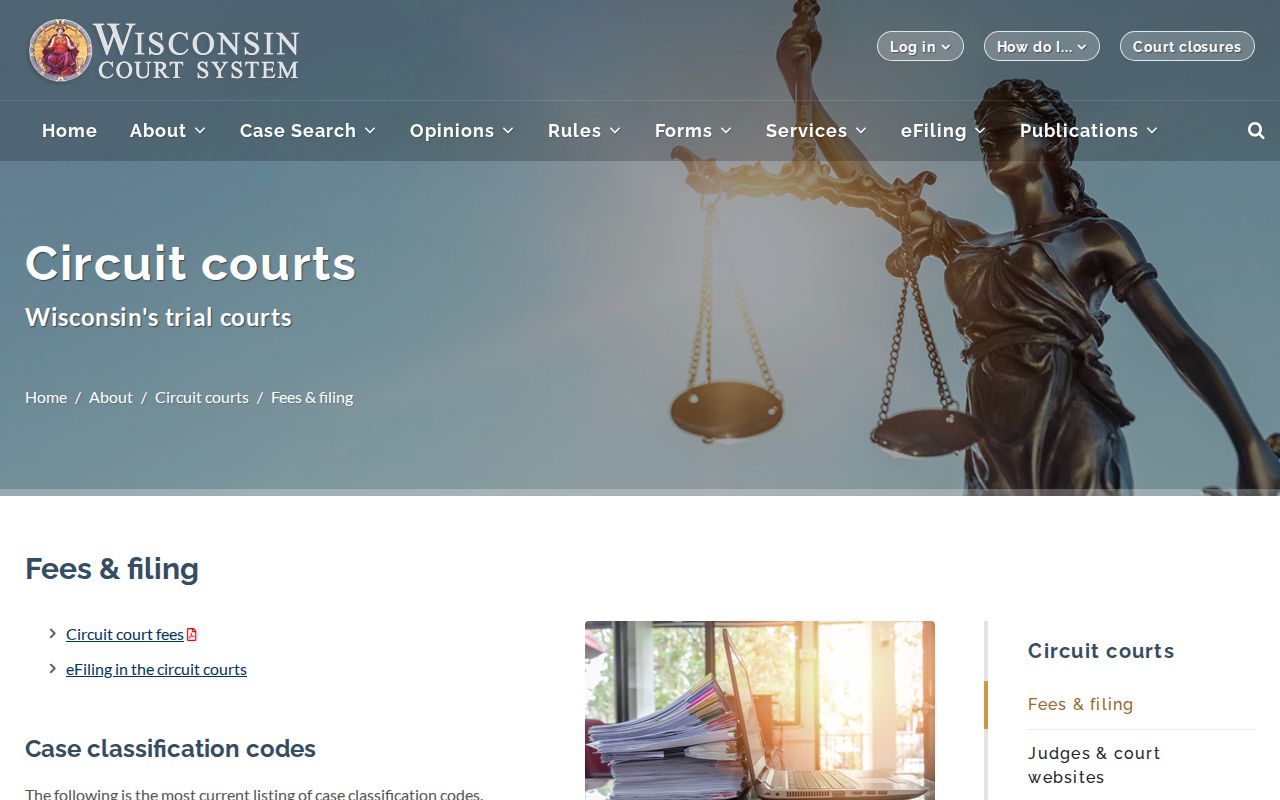
The official filing page reflects the codes used to open a case. A public result may show a shorter code. Compare it with the caption and the event history before you settle on what kind of civil record you have.
Types of Civil Cases on the Docket
Eau Claire County civil dockets cover many case families. These include general civil claims, small claims, and several petition-based matters. The forum and the access rules can differ from one to the next. Probate records route through the Register in Probate function. Juvenile cases are not a routine public category. Family files can hold financial, medical, child-related, placement, and protected-address information.
- Contract, money judgment, and debtor actions
- Personal injury and property damage claims
- Garnishment, condemnation, and foreclosure matters
- Contested and uncontested small claims
- Divorce, paternity, and other family cases
- Probate, estate, and guardianship proceedings
Go by the case type shown in WCCA. Do not assume every dispute follows the same pleading sequence, or that every docket item is open to online inspection.
Eau Claire Small Claims Split
The certified 2024 caseload report covers small claims. It splits them into contested and uncontested. Eau Claire County recorded 367 contested openings and 1,419 uncontested openings. Dispositions came in at 407 contested and 1,340 uncontested. Those numbers describe case flow, not trials. An uncontested opening can end without any contested hearing.
| 2024 small claims | Opened | Disposed | End pending |
|---|---|---|---|
| Contested | 367 | 407 | 60 |
| Uncontested | 1,419 | 1,340 | 185 |
Judgment rarely closes the visible record. A later Eau Claire County civil docket entry may show costs, garnishment, satisfaction, reopening, or appeal.
Settings and Hearings on Civil Dockets
A civil setting is a scheduled step, nothing more. Eau Claire County civil dockets list many setting types. A docket may show a scheduling conference, status conference, or mediation-related event. It may also show a motion hearing, pretrial, court trial, jury trial, or review. Write down the date, time, branch, judge, setting type, status, and location or remote indicator. Branch assignments can change. Remote details may sit outside the short event title.
Continued, reset, cancelled, adjourned, and held do not mean the same thing. Read the newest event and compare it with the latest notice. If a setting is urgent or recently changed, call the assigned branch or the clerk. A pending settlement or a filed motion does not cancel an appearance. The court must say so.
Note: Online events and prior paper notices can differ. The latest official notice and current clerk information control.
Eau Claire Civil Case Flow
Most Eau Claire County civil dockets begin at filing. The path may run through service, response, scheduling, motions, hearing or trial, and judgment. The real track depends on the claim. A small claim can move quickly to a return date. A general civil action may show long stretches of motion and discovery activity. Family petitions carry their own event labels. Probate work goes through a separate office function.
Civil docket flow: Filing › Service › Answer or Appearance › Scheduling › Motion or Trial › Judgment › Post-Judgment Activity
One docket line, one fact. Service alone proves no liability. A motion is only a request, not a ruling. The same goes for a scheduling conference, which settles nothing final. When you need the exact terms of an outcome, a judgment entry on the civil docket is just a pointer; the signed judgment or order held by the clerk is the record worth requesting.
Public Access to Civil Dockets
Wisconsin treats court records as open. Yet statutes, court rules, and case orders still shape that access. So an Eau Claire County civil docket can leave out confidential details. The public still sees the case exists. Family, paternity, adoption, guardianship, domestic-abuse, and juvenile files get special handling. So does financial and medical material. One rule protects everyone: keep protected personal identifiers out of any unrestricted filing.
Access boundary: Wis. Stat. §§ 19.31-19.39 state the public-records policy. Section 801.19 addresses protected identifiers, section 801.20 covers confidential court information, and section 801.21 provides a seal or redact process.
When an item is missing, ask the clerk directly whether it is restricted, sealed, simply not digitized, or sitting in archives. Use the least data needed for the search, especially in family matters. And never disclose a child's details, a protected address, account data, or private medical information.
Eau Claire Certified Civil Records
WCCA shows you the case and its events. It stops short of a full electronic file. The official Wisconsin access explanation sends the public to the county clerk for actual case documents. So name the item you want: a pleading, order, judgment, transcript, or exhibit. A plain copy is an ordinary reproduction. A certified copy carries the clerk's authentication plus a separate fee.
The current statewide fee table and Wis. Stat. § 814.61 govern copy and certification charges. Confirm the amount before ordering. The clerk can also tell you whether a large or old Eau Claire County civil file needs archive retrieval. Probate or guardianship material is different. Check first whether the Register in Probate is the right records office.
A strong request gives the case number, case family, parties, and the exact document. Add its approximate filing date, certification preference, delivery method, and contact details. That precision beats a broad demand for everything in the docket.
Eau Claire Family Docket Privacy
A family case summary can display public events. Financial, medical, child, placement, or protected-address details stay confidential. Search an Eau Claire County civil docket with the least data needed. Nothing more.
For a permissible copy, ask the clerk which part of the family file is public. Divorce information before 2016 routes to the Clerk of Courts under the county's vital-record guidance.
Eau Claire Probate Record Route
Probate, estate, and guardianship records run through the Register in Probate function. Its route and fee lines differ from an ordinary Eau Claire County civil file request.
The county posts no stable direct-contact page for that function. Start with the county court contact. Confirm the right office before sending any request or payment.
Eau Claire Civil Caseload Context
The certified 2024 report counts 3,080 civil matters opened in Eau Claire County, with 2,986 disposed and 889 pending at year end. It also logs transfers, reactivations, deactivations, and audit entries. Those figures describe court flow, not unique lawsuits. A single Eau Claire County civil docket can pass through more than one reported status in a year.